
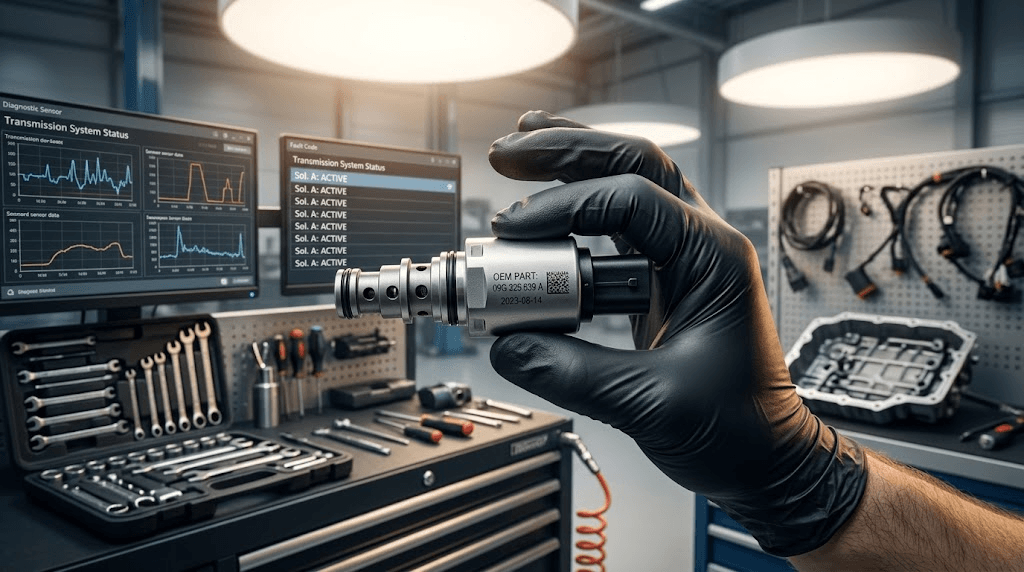
How to Read Laser-Etched OE Part Numbers on Automotive Solenoid Valves
When troubleshooting or replacing an electro-hydraulic component—such as an automatic transmission shift solenoid, VVT actuator, or EVAP purge valve—precision is critical. Installing a valve with an incompatible flow rate, incorrect internal resistance ($\Omega$), or a mismatched pinout can result in persistent diagnostic trouble codes (DTCs), transmission slipping, or severe mechanical failure.
The most direct and foolproof way to guarantee 100% component compatibility is by retrieving and decoding the laser-etched OEM part number directly from the original valve body.
1. Understanding Laser-Etched Markings on Solenoid Valves
Modern Tier-1 automotive component manufacturers (such as Bosch, Denso, Pierburg, and ZF) utilize laser marking systems on solenoid shells to provide permanent traceability. Because these components operate in extreme environments surrounded by high-temperature transmission fluid (ATF) or engine oil, printed labels would quickly degrade.
A standard laser-etched data block on a solenoid typically contains three distinct elements:
- The Master OEM Part Number: The primary reference used for direct vehicle fitment and electronic parts catalog (EPC) lookup.
- Production / Lot Date Code: Indicates the manufacturing date and production line for quality assurance and batch traceability.
- 2D Data Matrix / QR Code: A machine-readable matrix used during factory assembly and automated quality inspection.
2. Step-by-Step: How to Clean, Read, and Decode the Markings
Step 1: Clean the Metallic Casing
Before attempting to read the code, remove burnt oil residues, carbon buildup, or metal particulates from the casing:
- Spray the exterior shell with a dedicated quick-drying electrical cleaner or brake cleaner.
- Wipe gently with a microfiber or lint-free workshop cloth. Avoid using steel wire brushes or abrasive pads, as they can scratch through shallow laser etching.
Step 2: Optimize Lighting and Magnification
Laser markings on polished or machined aluminum/steel can create glare under direct overhead shop lights:
- Use angled, diffuse LED lighting to cast subtle shadows across the etched grooves.
- If the markings are faint, use a standard workshop magnifying glass or your smartphone’s macro camera mode.
Step 3: Differentiate Part Numbers from Date Codes
Do not confuse batch tracking codes with the actual OEM reference:
- OEM Part Number Format: Typically follows manufacturer-specific structured alphanumeric patterns (e.g.,
09G 325 039 Afor VAG 6-speed transmissions). - Date Code Format: Typically displayed in
YYYY-MM-DDformat (e.g.,2023-08-14) or week/year codes (e.g.,W33/23).
3. Common Solenoid OE Formats Across Major Manufacturers
| Brand / Platform | Example Part Number | Typical Component Application |
|---|---|---|
| Volkswagen / Audi Group (VAG) | 09G 325 039 A | Transmission Shift / Pressure Solenoid |
| BMW Group | 11 36 7 585 425 | VANOS Variable Valve Timing Solenoid |
| Mercedes-Benz | A 272 051 01 77 | Camshaft Adjuster Solenoid Magnet |
| Toyota / Lexus | 25860-28070 | Vacuum Switching Valve (VSV) |
| ZF Transmissions | 1068 298 043 | 6HP / 8HP Valve Body Solenoid Kit |
4. Cross-Referencing OE Numbers for Reliable Sourcing
Once you have recorded the exact OEM number from the defective part:
- Verify Electrical Specs: Always measure the coil resistance across terminals using a digital multimeter to confirm if the valve is a standard On/Off solenoid ($10,\Omega – 30,\Omega$) or a Pulse-Width Modulated (PWM) / Linear pressure control solenoid ($3,\Omega – 8,\Omega$).
- Check Interchange Databases: Use professional cross-reference catalogs to match the OEM part number to precision-engineered aftermarket replacements.
- Verify Connector Pinouts: Ensure the guide grooves and terminal pin configurations match the original vehicle harness exactly.
Precision-Engineered Solenoid Solutions by DYNZOR
At DYNZOR, we manufacture high-durability solenoid valves engineered to meet or exceed original equipment tolerances. Every unit undergoes strict dimensional checks, leak-down testing, and coil impedance verification.
Need assistance matching a worn or obsolete OE number?
Send your part numbers, technical drawings, or physical samples to our technical support team for rapid cross-referencing and direct factory quotations.